

Politics · Essay · New this week
Are We Really More Politically Divided, or Have We Just Become Better at Seeing Our Differences?
Social media makes Britain seem more politically divided than ever. But are our views really growing further apart, or are we simply seeing more of the disagreements that have always existed?
Diya Boparai · 27 October 2026
27 October 2026
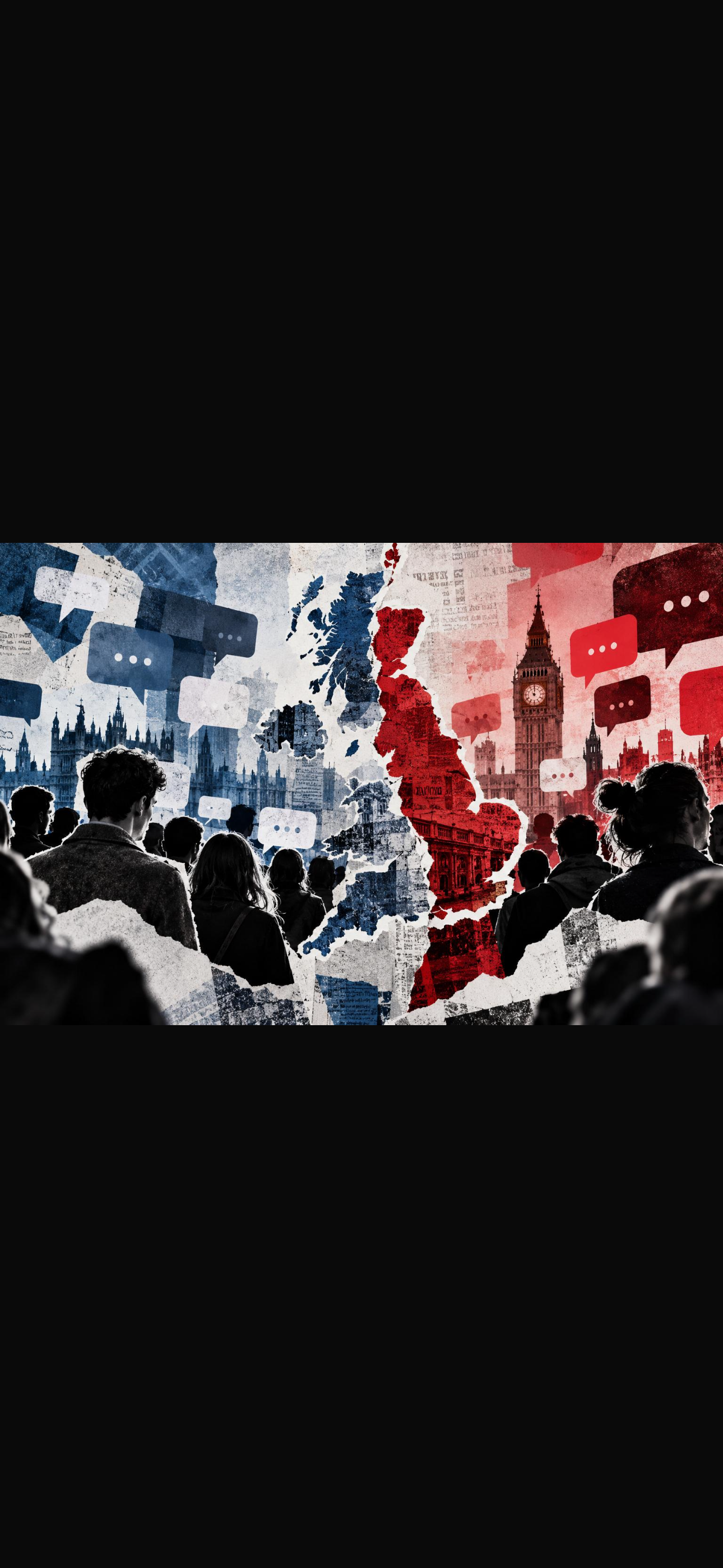
Spend a few minutes scrolling through the comments on a political post and you would be forgiven for thinking Britain is falling apart. Whether the subject is immigration, Brexit or the cost of living, people seem to have very little patience for anyone who disagrees with them. Even the most ordinary political opinion can turn into an argument.
It is easy to blame social media. We hear constantly about how algorithms create echo chambers and encourage extreme views. But I'm not convinced that seeing more political arguments necessarily means people have become more divided. Before social media, disagreements happened in workplaces, pubs and around dinner tables. Most went no further. Now, an argument between two strangers can be shared thousands of times and seen by people who would never otherwise have heard it.
Perhaps part of the problem is that we have never had such a clear view of what everyone else thinks. And what we see isn't always representative.
Are our beliefs really that different?
Political scientists distinguish between ideological and affective polarisation. The first concerns how far apart people's political beliefs are. The second concerns how much they dislike people who support the opposing side.
I think the second is particularly important. You can disagree with someone's views on taxation or immigration without thinking badly of them as a person. Yet political disagreements increasingly seem to become judgements about someone's character.
In Trigger Points, Steffen Mau and his colleagues challenge the idea that society is splitting into two completely opposed groups. Their research, based on Germany, suggests that people are not necessarily becoming more divided across every political issue. Instead, certain subjects, including immigration and climate policy, provoke particularly strong reactions (Mau, Lux and Westheuser, 2026).
Of course, Germany is not Britain, and we cannot assume the findings apply in exactly the same way. But the argument raises a question worth considering. When we talk about an increasingly divided society, are we describing a general shift in political beliefs, or are we focusing on a handful of issues that attract the most attention?
Research in Britain suggests that the picture is complicated. An Ipsos survey in September 2025 found that 85% of Britons believed society was divided, the same proportion recorded in 2018 (Ipsos, 2025). So although most people think Britain is divided, that feeling is not necessarily new.
Christopher Achen and Larry Bartels take a different approach in Democracy for Realists. They question the idea that most voters make political decisions by carefully weighing up competing policies. They argue that social identities and group loyalties play a much greater role than we might like to admit (Achen and Bartels, 2016). This helps explain something that otherwise seems strange: people can become fiercely loyal to a political side even when they do not agree with every policy it supports.
Brexit and the importance of belonging
Brexit is probably the clearest recent example of how political disagreements can become personal. The 2016 referendum asked one question about Britain's membership of the European Union. Yet the labels 'Leave' and 'Remain' quickly became much more than descriptions of how someone had voted.
Research by Sara Hobolt, Thomas Leeper and James Tilley found that these identities were strongly held and associated with prejudice towards the opposing group. They also crossed traditional party lines (Hobolt, Leeper and Tilley, 2021).
Someone who voted differently was no longer simply wrong about Britain's relationship with the EU. They could be seen as ignorant, selfish or out of touch. What interests me about Brexit is how quickly a single political question became part of people's identities. It suggests that hostility does not always require completely opposing views on every issue. Sometimes, belonging to one side is enough.
Social media undoubtedly played a role in the referendum and its aftermath. But it would be difficult to argue that it created the divisions on its own. Arguments about sovereignty, immigration and Britain's place in Europe existed long before Facebook and Twitter became central to political campaigning. This is one reason I am sceptical of explanations that place most of the blame for polarisation on technology.
What social media changes
That doesn't mean social media has no responsibility. One of its biggest effects may be on how we judge the opinions of other people.
Imagine that a politician makes a controversial statement. Hundreds of people might respond angrily, and the most provocative replies may attract the greatest attention. Someone scrolling through the discussion could easily conclude that everyone holds an extreme opinion. But the people commenting are not necessarily representative of the people reading. Many users never post about politics at all. Others avoid expressing their views because they do not want to get involved in an argument.
This creates a problem. We often treat what we see online as a reflection of public opinion, even though the people most willing to argue may be the least representative of it.
Ekaterina Zhuravskaya and her colleagues examine the political effects of the internet and social media in a review of existing research. One thing that stands out is how difficult it is to make a single claim about their effects. Social media can encourage political participation and help people access information, but it can also contribute to misinformation and other harmful political outcomes. Much depends on the context (Zhuravskaya, Petrova and Enikolopov, 2020). I think this is more convincing than the popular claim that social media is simply destroying democracy.
After all, being exposed to political disagreement is not necessarily harmful. It could encourage someone to question their own assumptions. The difficulty arises when the most hostile or extreme examples become the ones we see most often. If every political post presents the opposing side at its worst, it becomes easier to believe that those people are unreasonable. And once you believe that, why would you bother listening to them?
Perhaps the divisions are real after all
There is a weakness in my argument so far. Just because social media exaggerates political conflict does not mean the underlying disagreements are insignificant.
Britain has genuine economic and social divisions. Housing costs, wages and access to opportunities vary considerably depending on where someone lives. People who feel they have been left behind may have good reasons to distrust politicians who promise change but seem unable to deliver it.
Jonathan Hopkin explores some of these issues in Anti-System Politics, arguing that economic policies and the consequences of financial crises have helped fuel support for anti-establishment movements (Hopkin, 2020). This offers an explanation for political anger that has little to do with what appears on someone's phone.
If people feel that the political system is not working for them, they may become more willing to support parties or movements that challenge it. Social media can spread those messages, but it does not necessarily create the dissatisfaction behind them.
There is also evidence that the sense of division is growing. Research by More in Common found that the proportion of Britons who described the country as divided had risen from 54% to 64% since it began tracking this in 2022. However, the same research found that 55% still believed the differences between Britons were not so great that people could not come together (More in Common, 2026). This suggests that feeling divided does not always mean believing those differences are impossible to overcome.
I also think it would be a mistake to assume that every disagreement is evidence of polarisation. People have legitimate reasons to hold different views about immigration, taxation and public spending. Democracy would be rather pointless if everyone was expected to agree. The real problem is not that people disagree. It is when disagreement becomes hostility, and when political opponents stop being seen as people whose arguments deserve consideration.
So are we becoming more divided?
I began with the question of whether Britain is genuinely becoming more polarised or whether social media has simply made political disagreements harder to ignore. Having looked at the research, I don't think the answer is entirely one or the other.
There is evidence that political identities can produce genuine hostility, as the Brexit referendum demonstrated. Economic inequality and distrust of institutions also provide reasons why people might feel increasingly dissatisfied with politics. But none of this proves that the average person holds more extreme political beliefs than before.
Social media complicates the picture because it gives us constant access to other people's opinions without telling us how representative those opinions are. A few thousand angry comments can make an entire country appear furious.
I am therefore more persuaded by the argument that social media amplifies political divisions than by the claim that it is their main cause. It makes disagreements more visible and may intensify some of them, but the reasons people become politically divided are often much older and more complicated.
This matters when we consider possible solutions. Changing how platforms recommend political content might help reduce hostility online. It would not, however, resolve economic inequality, rebuild trust in Parliament or make people feel better represented.
I also wonder whether repeatedly describing Britain as a hopelessly divided country could become part of the problem. If people are constantly told that those on the other side hate them, they may begin to approach every political disagreement expecting hostility. We should be able to disagree strongly without assuming that everyone who thinks differently is a bad person.
Perhaps Britain is more divided in some ways than it used to be. But I suspect we are also much more aware of those divisions, particularly the loudest and angriest ones. And if we mistake the most extreme voices for the views of everyone else, we risk making the country seem more divided than it actually is.
Bibliography
Achen, C. H. and Bartels, L. M. (2016) Democracy for Realists: Why Elections Do Not Produce Responsive Government. Princeton: Princeton University Press.
Hobolt, S. B., Leeper, T. J. and Tilley, J. (2021) ‘Divided by the Vote: Affective Polarization in the Wake of the Brexit Referendum’, British Journal of Political Science, 51(4), pp. 1476–1493.
Hopkin, J. (2020) Anti-System Politics: The Crisis of Market Liberalism in Rich Democracies. Oxford: Oxford University Press.
Ipsos (2025) ‘85% of Britons continue to believe that Britain is divided as over half think differences in people’s political views are so divisive that it is dangerous for society’, 3 October.
Mau, S., Lux, T. and Westheuser, L. (2026) Trigger Points: Inequality and Political Polarization in Contemporary Society. Bristol: Bristol University Press.
More in Common (2026) ‘The state of social cohesion in 2026’, 9 January.
Zhuravskaya, E., Petrova, M. and Enikolopov, R. (2020) ‘Political Effects of the Internet and Social Media’, Annual Review of Economics, 12, pp. 415–438.
The author
Diya Boparai is a Year 12 student at Brampton Manor Academy, studying Politics, Geography and English Literature. She is particularly interested in politics, international relations and how political decisions affect society. She enjoys exploring different perspectives on current affairs and questioning widely held assumptions.
All work by this author →Read next, in Politics