

Philosophy · Essay · The Weekly, No. 6
Beyond Form: The Continuity of Japanese Architectural Philosophy
Saloni Rege · University of Washington, Seattle · 7 September 2026
University of Washington, Seattle · 7 September 2026
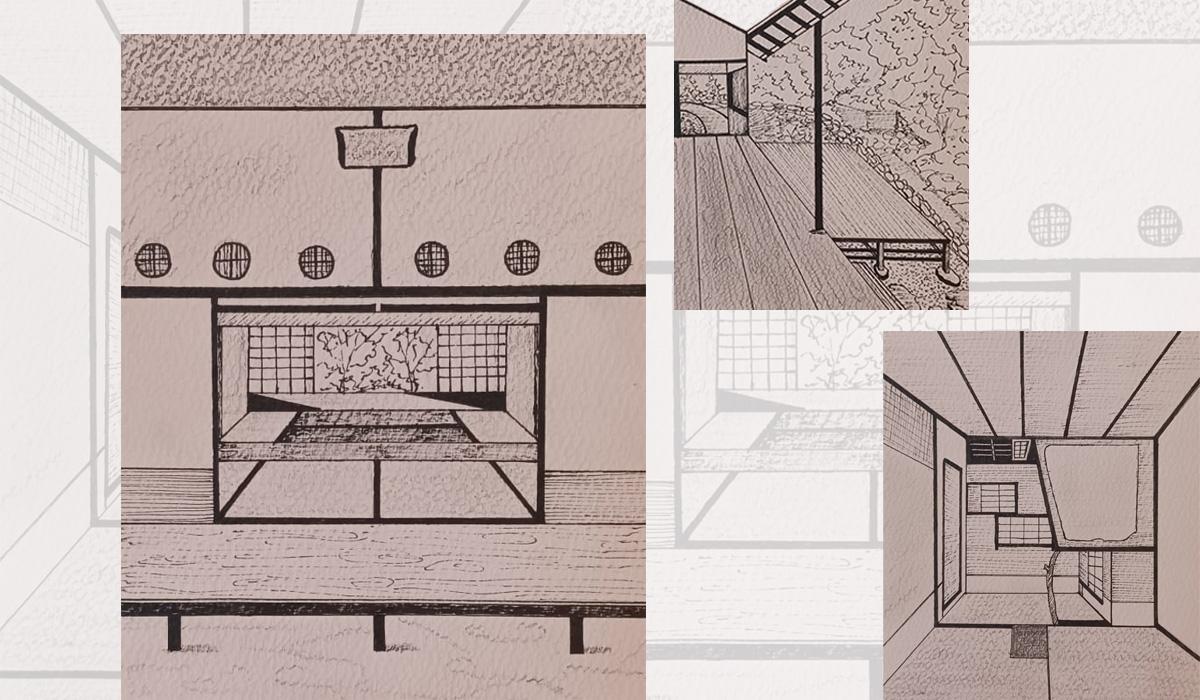
Soaked in the illusions, philosophies, and realities of the world, Japanese architecture has been a transformative thread between its traditional realm and western aspirations with design narratives that live in the paradox of time often projecting varied perceptions of it. According to William H. Coaldrake’s philosophy on Myths and Realities of Japanese Buildings, “what is seen is frequently not there and far more is present than is actually seen.” This serves as a parameter to comprehend the complexities of Japanese architecture that render simplicity to the human eye but in reality are interspersed with function, tradition and symbolism. Complexity is wrapped into a humble front that conceals opulence and unveils the Japanese ideology of remaining attached to their matted (tatami) floor; staying grounded.
Nuances of the vernacular Japanese homes are reflected in the age-old philosophies, if not in its physical elemental form. This is where a juxtaposition of tangibility and intangibility comes into play. Evident from Minoru Takeyama’s “About Diversity: Interpreting Japanese Residential Architecture,” it is clear that mass-produced unit homes have changed the shape of Japanese residences and ways of living. According to the author, the ideal way of Japanese architecture is to pursue durability and not lightness, which in fact should be a temporary bypasser. But, be it westernized forms, functions or terminologies like ‘Party walls’, their character has already been injected into Japanese architecture.
As rightly revealed in Azuma Takamitsu’s “Transformations of the Tatami-Mind,” modernization in Japanese architecture objectively began after the Meiji Revolution of the 19th century. However, the author here is driven by the symbolic value of Japanese elements to focus on the positive aspects of modernization and continues to believe that irrespective of aesthetic or functional changes, the symbolism of Japanese architecture continues to live on in its residences. This indeed is a form of architectural co-existence.
Japanese architecture is governed by simplicity and honest usage of materials. Even in the absence of a physical tatami floor in the newer dwellings, there’s a potential for temporary spaces to exist that serve as a nook for interaction or recuperation. The symbolic essence of a tatami-mind—architectural space formation—resonates with both the relevance of the old and the demands of the new. This is also where the concept of polyphony in architecture has a scope to develop synchronously. With the ability of polyphony comes the attitude of acceptance as well as adaptability. The ethos of Japanese architecture expects to comprehend the design of vertical spatial composition in order to curate a residence in a compact, neighboring site of the ever-evolving westernized city.
The interspersing act of this preordained relativity further echoes the idea of ma. The exhibit titled “Ma, Space-Time in Japan” at Cooper-Hewitt museum in 1979 unveils ‘The art of ma’. It stresses on equating space and time, thriving in the in-between, which is what the cosmos is aligned to. Japanese architecture also embodies the divinity of kami that represents the symbols of cosmos. This accounts to the presence of elements like rocks, stones, gravels, turtles and the likes of it being an essential part of the Japanese homes as well as gardens. It seems like diametrically opposite opinions are lingering in the air of Japanese design criticism but the underlying meaning of its philosophies is still a pivotal part of Japanese architecture, no matter how modernly fashioned it gets.
Ultimately, the recorded texts and exhibits suggest that the ideologies and fundamentals of Japanese architecture are so deeply rooted in its ways of living and thinking that, even as their physical manifestations disappear amid the modernization of design, their cultural continuity does not necessarily depend on the preservation of traditional forms. The Japanese spiritual symbolism and cultural context continue to endure—through reinterpretation rather than replication.

The author
Saloni Rege is an Architectural Designer, Writer, and MarComms Specialist working across the AEC industry in India and the United States. She holds an MS in Architecture History & Theory from the University of Washington, Seattle and continues to contribute to the PNW design culture. Her work explores the relationship between design and dialogue, having crafted articles for ELLE Decor India, Seattle DJC, ARCADE Northwest, and regional publications.
All work by this author →Read next, in Philosophy
- The Knight of Faith Aaron Sun
- The Eudaimonist Reconciliation of Pragmatic and Ideal in Plato and Aristotle Max John Antoni Juszkiewicz
- Jung, Bergman, and the Mask That Never Comes Off Esteban Werner