
Literature · Essay · New this week
The Other Lion: Aslan, the Incarnation and "Us Lions"
How Lewis' unnamed side character displays Christ's condescension.
R.C. Horton · 9 October 2026
9 October 2026
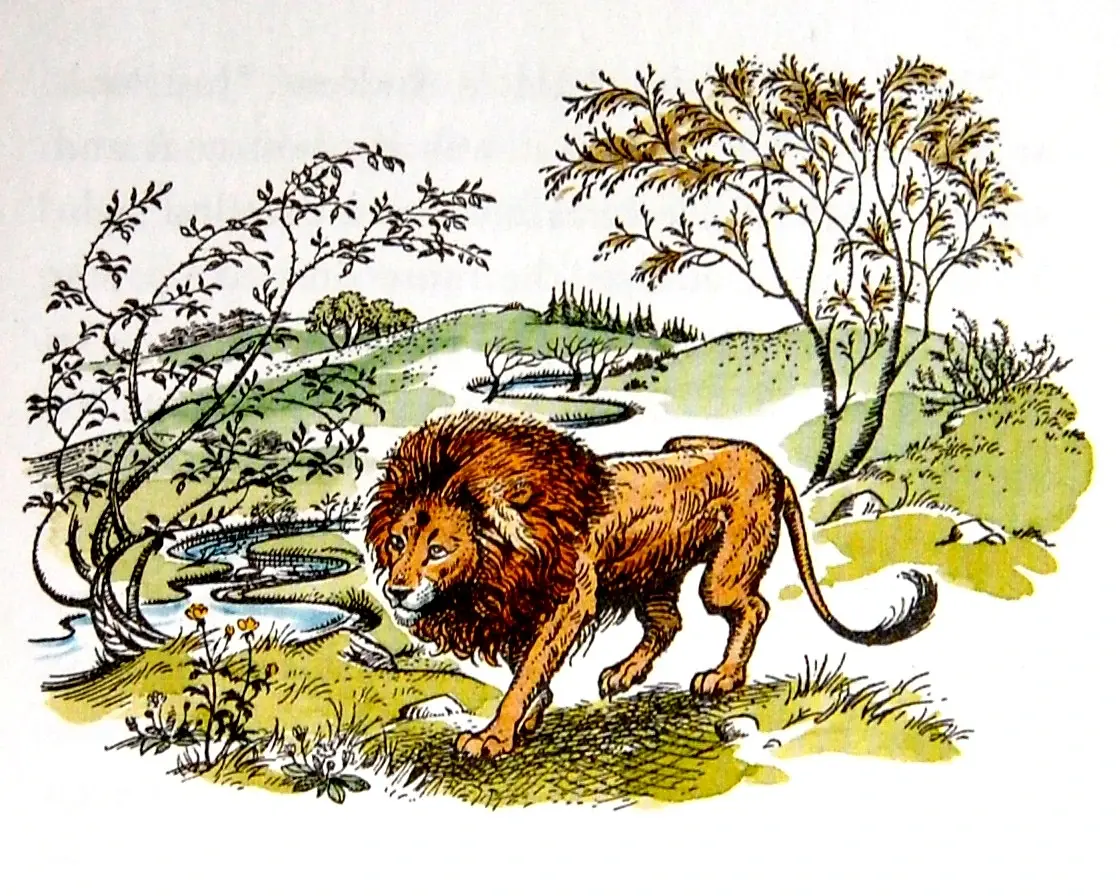
The most prominent character in C. S. Lewis's The Chronicles of Narnia is the lion Aslan. He is left burned into the memories of anyone who reads that wonderful story. A character of great renown and remarkable import, every line seems to sing his praise whether or not he graces the page with his presence. He is a lion, echoing the description of Christ as the "Lion of Judah." He is set apart clearly from the other characters in the series as a king, not unlike our understanding of the lion as the king of the jungle. In addition to all of this, there is one more important fact about him.
He is not the only lion.
Rather, he is joined in The Lion, the Witch and the Wardrobe by another lion. A mere several lines tell of this lion. In those lines, and in the fewer still in which he speaks, Lewis beautifully illustrates the love of God for us displayed through Christ's descent into the form of Man. To sufficiently articulate that illustration, one must first understand the position of Aslan in the world of Narnia.
Aslan is the one constant throughout the entire series, present even when his name is not spoken aloud or his presence is not explicitly written on the page. This is most readily apparent when he influences the events of The Horse and His Boy, not naming himself as he chases the titular characters into meeting another set of important companions, and appearing as a cat to comfort and defend the boy in his sleep.
He is first made known to us in the first published book in the series. In this book, Lewis outlines the entirety of Christ's incarnation and ministry on Earth. From the very first page to the very last, Aslan is distinct among all the creatures in Narnia. He orchestrates all the events. He is the only one able to sacrifice himself in place of another for their transgressions, perishes and comes back to life, and is king above all other kings and queens of Narnia.
What else is there to say that our wonderful Mr Beaver hasn't said already?
"Don't you know who is the King of Beasts? Aslan is a lion, the Lion, the great Lion."
Throughout most of the series, Aslan is treated as anything but a common lion. He sits far above the creatures of Narnia, "King of the wood, and the son of the Emperor beyond the sea," as Mr Beaver states in that very same chapter. Aslan's conduct fits the biblical definition of holiness. Aslan is not a mere creation in Narnia, but the foundation of it, separate not only from the dumb beasts who cannot speak, but sitting loftily above the speaking beasts and even the human kings and queens of Narnia.
Contrariwise, the form Aslan takes is not distinct. That is not to say that the lion is not a grand and majestic creature. After all, we don't describe them as king of the jungle without cause. The lion, however, is not an uncommon beast even in Narnia. While they aren't described in great numbers throughout the series, common lions are stated to live in the Western Wilds. One such lion's pelt is used by the scheming Shift to disguise the donkey Puzzle as Aslan, a feat that would only be possible if Aslan was not visually distinct from any other lion.
The only other lion with dialogue is written in that first book. Nameless, Lewis simply refers to him as "the other lion." This character is a minor one in the overarching story. Most adaptations either ignore him or change him. The Disney film presents a lioness, and gives her no lines. While this is a minor change in the story itself, I believe it undercuts the intention of the character.
Statues, creatures from foxes to fauns frozen in place by the White Witch, line the halls of her castle. Resurrected following his sacrifice upon the Stone Table, Aslan takes Susan and Lucy there during the final battle of the book, setting them free from their prison of stone. Among those animals is the other lion, briefly mentioned during Edmund's stay in the Witch's house. This lion is not made distinct in appearance from Aslan, being described simply as a lion with no additional elaboration. No attempt is made to render this lion lower than Aslan in appearance, especially not by Aslan himself, who gives instructions to the other rescued creatures to follow "us lions" into battle, a fact that gives this lion great joy.
"The most pleased of the lot was the other lion, who kept running about everywhere pretending to be very busy but really in order to say to everyone he met, 'Did you hear what he said? Us lions. That means him and me. Us lions. That's what I like about Aslan. No side, no standoffishness. Us lions. That meant him and me.'"
Despite being called son of the Emperor beyond the sea, and despite holding very real authority and power over Narnia, Aslan has taken the form not of a great and powerful being, but of a mere lion, like this one. He does not act as though he is standing over all Narnia, but takes part in Narnia among these creatures, not above them. In a few mere lines given to this character, Lewis shows us one great beauty of Jesus' gospel.
And what a beauty it is that the Son of God the Father would come down to us in this manner, not claiming equality with the Father, but taking the form of mere man in all his struggle, pain, and temptation. David describes the lowness of Man as he wrote the Psalms, never better than when he showed his insignificance in comparison to the vastness of the universe, writing "What is man that you are mindful of him, and the son of man that you care for him?" The author of Hebrews later quotes this verse, and elucidates the love of God in Christ's incarnation into the form of Man.
"For we do not have a high priest who is unable to sympathize with our weaknesses, but one who in every respect has been tempted as we are, yet without sin. Let us then with confidence draw near to the throne of grace, that we may receive mercy and find grace to help in time of need."
In the midst of writing of His glory and power, he takes a beat to recognize the sacrifice, not only in death, but in making Himself low in the form of man. The Son left the bosom of the Father, a perfect love that He had experienced for eternity, and stepped into our form, experiencing separation from that love. Few have written about this as well as John Flavel, telling us of the love of both God the Father and God the Son in His condescension from the divine into a form of flesh.
"And how astonishing is the love of Christ that would make such a stoop as this to exalt us! Oh, it is ravishing to think he should pass by a more excellent and noble species of creatures, refusing the angelic nature to take flesh; and not to solace and disport himself in it neither, nor experience sensitive pleasures in the body, for, as he needed them not, being at the fountain-head of the highest joys, so it was not at all in his design, but the very contrary, even to make himself a subject capable of sorrows, wounds, and tears."
Narnia is often read as one of the most straightforward allegories for the gospel in fiction, to the point that it was a point of contention between Lewis and Tolkien. Lewis himself referred to it as a supposal, and I agree with his assessment. Aslan is not merely a character that mimics Christ, but is written to be Christ as He might appear in another world. In that world, He doesn't appear as a creature above creation; He appears as a lion.
One of "us lions."
Bibliography
Lewis, C. S. The Lion, the Witch and the Wardrobe. First Harper Trophy edition. New York: HarperTrophy, HarperCollins Publishers, 2000. ISBN 0-06-440942-2. Pages 79 and 174.
Flavel, John. The Fountain of Life: A Display of Christ in His Essential and Mediatorial Glory. Reprint. Corner Pillar Press, 2013. First published London: W. Baynes and Son, 1820. ISBN 978-0-9844320-8-0. Sermon IV, page 69.
The Holy Bible, English Standard Version. Psalm 8:4; Hebrews 4:15–16.

The author
Musician, poet, author. Seeking to be the voice of the layman, that he might join the discussion and be taken seriously.
All work by this author →Read next, in Literature
- Under His Eye: Surveillance, Religion, and Control in The Handmaid's Tale Evan Rogers
- Cædmon's Chronicle Alexander Birch
- The Ruin Aneirin Sprake-Harris