

Classics · Essay · The Weekly, No. 14
Before Writing: How the Ancient World Communicated Without a Page
From oral memory to written word — what ancient communication reveals about how we remembered, what we passed on, and what we may have lost.
Yoana Nikolova · University of Liverpool · 8 November 2026
University of Liverpool · 8 November 2026
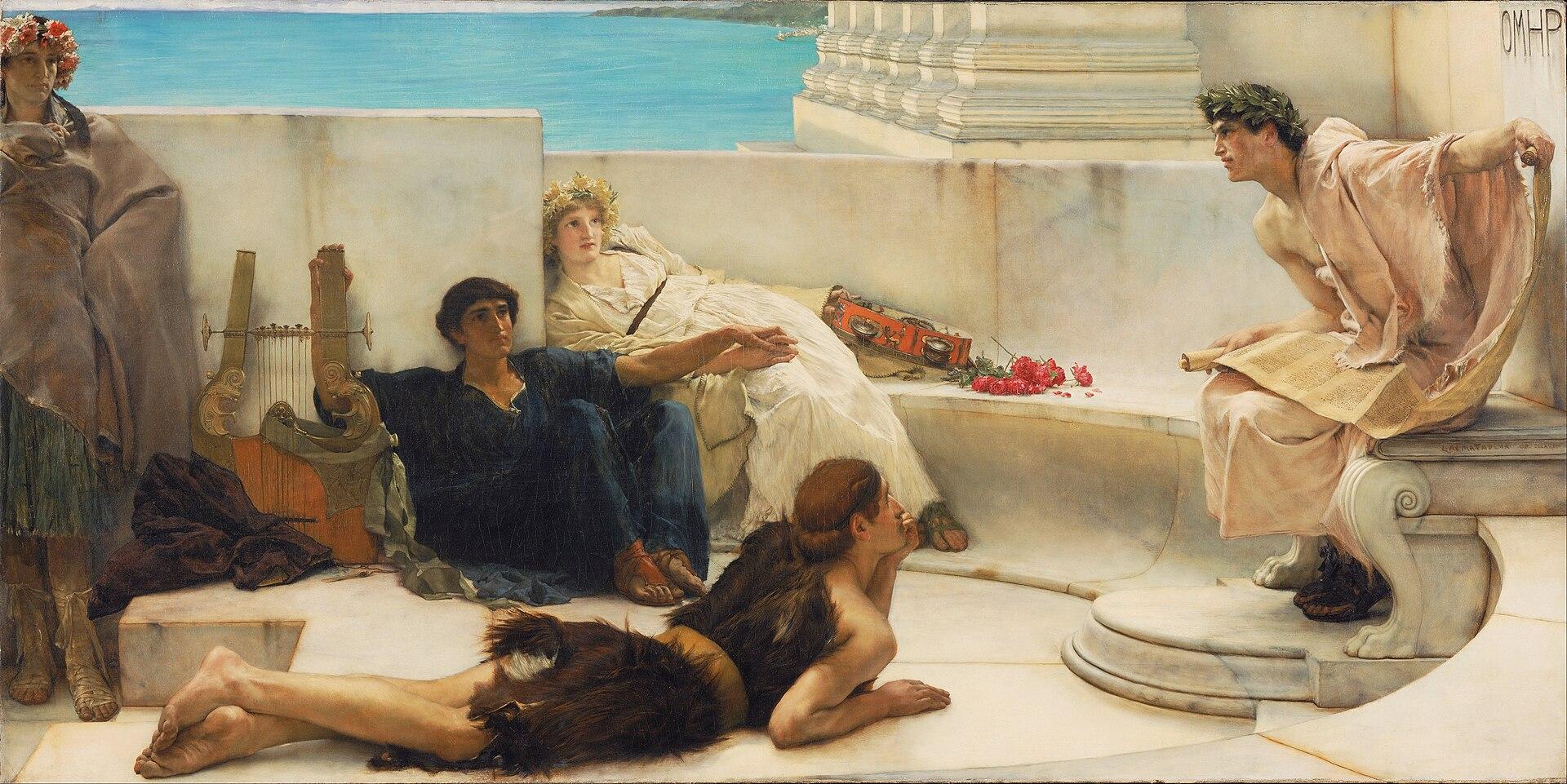
Long before anyone in the ancient Mediterranean set a stylus to wax or reed pen to papyrus, entire civilisations were already communicating with extraordinary sophistication — they were just doing it out loud.
It’s tempting to think of the ancient world as a slow, patient build-up to the “real” communication technologies we recognise: writing, then print, then everything after. But that framing undersells what oral cultures were actually doing — and, as it turns out, it undersells what writing itself was doing once it did arrive, since the earliest Greek script was doing something stranger and more various than simply recording speech. Long-form oral traditions like the Homeric epics weren’t primitive placeholders for literature — they were finely engineered systems for storing and transmitting knowledge across generations, in a world where a memory lost with someone’s death was gone for good. Herodotus makes the stakes explicit in the opening line of his Histories, explaining that he writes so that “the deeds of men may [not] be forgotten by lapse of time” and that the achievements of Greeks and non-Greeks alike should not “lose their renown” (Herodotus, Histories 1.0, trans. Macaulay, 1890). Communication, for Herodotus, is quite literally a defence against oblivion.
Memory as technology
Open the Iliad or the Odyssey and you’ll notice something almost immediately: the repetition.
Achilles is “swift-footed” (ποδάρκης) dozens of times. The sea is “wine-dark” (οἶνοψ πόντος) whether or not that colour makes literal sense in context. Dawn is “rosy-fingered” (ῥοδοδάκτυλος ἠώς) again and again. Modern readers sometimes find this monotonous and strange — why describe something the same way over and over, when we’re trained to prize variety in our vocabulary? But these fixed epithets weren’t a stylistic tic; they were load-bearing infrastructure.
In the 1920s and 30s, the classicist Milman Parry set out to explain why Homeric verse was so saturated with recurring phrases. His answer was that these weren’t decorative flourishes or a lack of vocabulary but functional units — what he defined as a fixed group of words, matched to the metre, that a poet could reach for instantly to express “a given essential idea” (Parry 1930: 80). Parry, and later his student Albert Lord, showed that a poet composing live, in front of an audience, with no script to fall back on, needed a stock of ready-made building blocks to keep the hexameter intact while improvising thousands of lines from memory. Their fieldwork among still-living oral poets in the former Yugoslavia, described in detail in Lord’s The Singer of Tales (1960), gave the theory its most persuasive evidence: illiterate singers really could produce epic-length narrative on the spot, using exactly this kind of formulaic scaffolding.
The literary theorist Walter Ong later drew out the wider implications of this for how oral societies thought at all. In a culture with no written archive, once knowledge was acquired it had to be constantly repeated or it would be lost, so that, as Ong puts it, “fixed, formulaic thought patterns were essential for wisdom and effective administration” (Ong 1982: 24). Formula, on this reading, wasn’t just a poet’s trick for keeping the metre — it was how an entire society kept its working knowledge from disappearing from memory.
Eric Havelock pushed the implications of this further still. In Preface to Plato (1963), he argued that Homeric formula wasn’t just a performance aid but a genuine memory technology — a way of encoding a culture’s practical knowledge, ethical norms, history and law in a form durable and portable enough to survive without any written archive at all. Havelock went so far as to devote a chapter to what he called “The Homeric Encyclopedia” (Havelock 1963: ch. 4): a repository of everything a Greek needed to know about warfare, hospitality, honour and the gods, held in a form built to be memorised and performed, rather than consulted on a shelf.
It’s worth mentioning one common misconception this picture can encourage, though: that the oral poet was purely a vessel for improvisation, incapable of the private, reflective craft we associate with writing. The classicist Rosalind Thomas pushes back on exactly this assumption. Drawing on evidence that oral singers frequently rehearsed and refined set-piece scenes alone before performing them, she argues that “care is not the monopoly of the literate” (Thomas 1992: 40) — that an oral poet could work and rework a passage in private, memorise it, and slot it into a fluid performance, without writing ever entering the process. The Homeric bard, in other words, wasn’t simply channelling tradition on the spot; in his own way, he could also revise.
An oral culture wasn’t a culture that hadn’t yet learned to communicate properly. It was a culture that had built an entire cognitive and social infrastructure — metre, formula, genealogy, myth — specifically so that its most important knowledge could travel through people rather than through objects.
Myth as a delivery system
Once you see myth this way, its content starts to look different too. Hesiod’s Works and Days is often read as agricultural advice wrapped in poetry, but it’s really the other way round: it’s a system of ethical and practical instruction that uses poetic form, memorable narrative, and divine sanction to make sure the information sticks — and that it carries enough authority to be obeyed.
The Egyptologist and cultural historian Jan Assmann offers a useful vocabulary for what’s happening here. He argues that every culture builds what he calls a “connective structure” — a shared fund of knowledge and memory that binds a group together across both time and society — and that “the basic principle behind all connective structures is repetition” (Assmann 2011: 3). Myths, on his account, function as “figures of memory”: fixed, symbolic points that a culture returns to again and again, using them to explain and legitimate its present. Crucially, Assmann argues, this process doesn’t distort history so much as constitute it as something usable: “through memory, history becomes myth” (Assmann 2011: 38), and it is precisely this transformation — not a failure of accuracy — that gives a foundational story its lasting, normative power.
That combination of technical constraint and genuine creative invention — finding the right image, the right rhythm, the right structure to make an idea unforgettable — is itself a kind of communications craft, one that predates anything we’d call “media” by millennia.
Writing before rationality
It’s tempting, once writing does appear, to imagine it immediately doing what we expect writing to do: recording information, neutrally and functionally, for later reference. The evidence from early Greece resists this. Rosalind Thomas argues that it is “naïve…to regard all writing as…purely functional” (Thomas 1992: 75), and the Greek case makes the point vividly. Well into the classical period, Greece had no single standard alphabet at all: individual city-states used their own regional letter-forms, and it wasn’t until the end of the fifth century that Athens formally adopted the Ionic alphabet, which then spread elsewhere. Thomas describes this as a case of “variety of function and symbolic meaning” existing even before any centralised system of schooling could enforce uniformity (Thomas 1992: 75).
Some of the more striking evidence for this comes from curse tablets (defixiones): thin sheets of lead, inscribed with a curse against an enemy, then folded — sent, in effect, to the underworld like a letter — and buried or hidden away. The efficacy of the curse didn’t depend on its being written down at all; curses had been spoken for centuries before anyone thought to inscribe them. Writing here wasn’t conveying new information so much as intensifying an existing oral act, giving it a physical, buried permanence. Early inscriptions could be similarly unconcerned with legibility in the modern sense: some archaic Greek writing runs in boustrophedon, alternating direction line by line “as the ox ploughs,” with letters occasionally mirror-reversed — a practice that lingered long after left-to-right writing had become the norm. Rather than reading this as primitive fumbling, Thomas suggests it reflects “a refreshing creativity and imagination in writers’ approach to the medium” (Thomas 1992: 76): early Greek letters were treated less like a transparent code for speech and more like a visual, almost sculptural material, in their own right.
What changed, and what didn’t
The eventual arrival of widespread literacy didn’t simply replace this system — it ran alongside it, competed with it, and in some cases mourned it. Plato dramatises this anxiety directly in the Phaedrus, in the myth of the Egyptian god Thoth, inventor of writing, who presents his discovery to the king Thamus as a gift that will make people “wiser” and improve their memories. Thamus is not convinced. Writing, he warns, will produce forgetfulness in the soul, because people will stop exercising memory and rely instead on “external written characters and not remember of themselves.” What Thoth has really invented, Thamus concludes, is “an aid not to memory, but to reminiscence” (Plato, Phaedrus 274c–275b, trans. Jowett) — a way of appearing wise without the substance of wisdom itself, one that will “appear to be omniscient and know nothing.”
Walter Ong helps explain why Plato’s anxiety was, in a sense, well-founded. Writing, he points out, was not simply speech transcribed; it was a genuinely new technology, and one that achieved “the separation of the word from the living present” (Ong 1982: 80) in a way nothing before it had. Plato was writing at exactly the moment that alphabetic literacy was first being deeply interiorised in Greek culture — which is one reason, Ong suggests, that Plato could describe writing so suspiciously even while his own philosophical method depended on it entirely.
Sound familiar? It’s a strikingly recognisable anxiety, echoed centuries later almost verbatim in worries about calculators, search engines, and now AI. And it points to something Ong made central to his work: that the shift from orality to literacy wasn’t a neutral upgrade in efficiency but a genuine transformation of thought itself. As he put it, “more than any other single invention, writing has transformed human consciousness” (Ong 1982: 77).
Conclusion
Learning to write is learning to think in a new way — more linear, more abstract, more able to hold an argument at a distance, analyse it, and revise it. But something was lost along the way: the immediacy, the communal performance, the reliance on one’s own trained memory that oral culture demanded and rewarded.
What’s clear from the ancient evidence, oral and written alike, is that communication and creativity were never separate concerns, and that the line between them was never as clean as the old story of “orality giving way to literacy” suggests. The formal constraints of epic metre didn’t limit invention; they were the occasion for it. Inscriptions weren’t merely records; they were monuments, curses, offerings, and works of visual craft in their own right. The need to be remembered shaped how stories were built, line by line, in a society that understood — long before “content strategy” was a phrase anyone used — that poetry held a central place in archaic Greek life precisely because it was memorable and structured enough to be “one of the few effective forms of preservation” (Thomas 1992: 51). How you said something, and what you said it on, was never separable from whether it survived to be heard at all.
Bibliography
Primary sources
Herodotus. Histories, Book 1. Translated by G. C. Macaulay (1890).
Hesiod. Works and Days. Translated by H. G. Evelyn-White (1914).
Homer. Iliad and Odyssey. Translated by R. Fagles (1990–1996).
Plato. Phaedrus, 274b–278e (the myth of Thoth and Thamus). Translated by B. Jowett (1892).
Secondary sources
Assmann, J. (2011). Cultural Memory and Early Civilization: Writing, Remembrance, and Political Imagination. Cambridge: Cambridge University Press.
Havelock, E. (1963). Preface to Plato. Cambridge, MA: Harvard University Press.
Lord, A. (1960). The Singer of Tales. Cambridge, MA: Harvard University Press.
Ong, W. (1982). Orality and Literacy: The Technologizing of the Word. London: Methuen.
Parry, M. (1930). “Studies in the Epic Technique of Oral Verse-Making I: Homer and Homeric Style.” Harvard Studies in Classical Philology 41: 73–147.
Thomas, R. (1992). Literacy and Orality in Ancient Greece. Cambridge: Cambridge University Press.

The author
First Class (Hons) BA in Archaeology of Ancient Civilisations | Specialising in Myth, Reception, and Visual Culture in Ancient Greece | MA in Art, Philosophy and Cultural Institutions
All work by this author →Read next, in Classics
- Six Red Months Yoana Nikolova
- The Pompeian Businesswoman: Julia Felix and Women in the Roman Economy Charley Clasby
- “Money Makes the Man”: Pindar’s Poetic Persona and the Politics of the Aristocracy Holly Mia Garside