

Philosophy · Essay · The Weekly, No. 16
Once Upon a Dream: On the Allegorical Nature of Disney’s Sleeping Beauty
Sleeping Beauty is not just a story about good and evil, but about love and death, and the triumph of love over death
Anthony J Kleem · 20 November 2026
20 November 2026
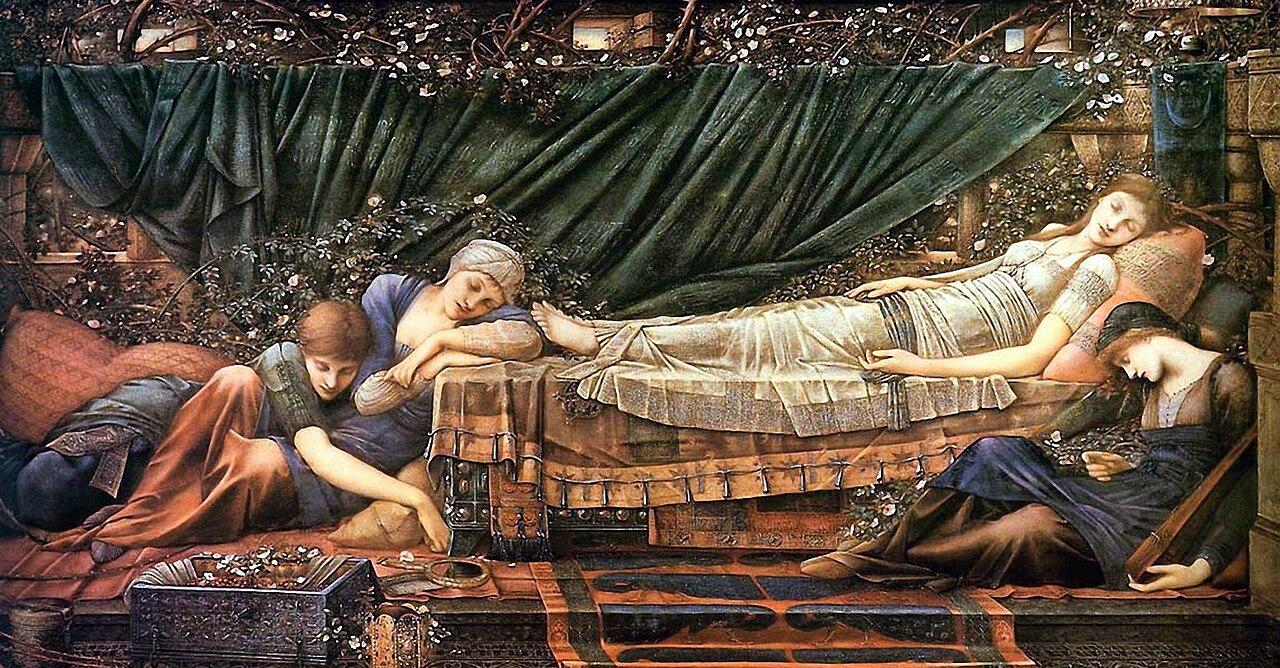
Sleeping Beauty (1959) is one of the finest animated features Disney Studios produced. The film has a striking medieval aesthetic that evokes books of hours, tapestries, and Gothic architecture, but the medieval elements are more than merely aesthetic. The story of a prince who confronts Hell, slays a dragon, and awakens his beloved can be read as a Catholic fable. Prince Phillip figures Christ, Maleficent represents Satan, and Princess Aurora represents fallen humanity, or more specifically, the Church. Sleeping Beauty is therefore not merely a story about good and evil, but about love and death, and the triumph of love over death.
Medieval writers interpreted Scripture in four layers: the literal level (what the narrative is literally doing), the allegorical level (what the narrative means symbolically), the moral layer (the lesson we are meant to take away), and the anagogical layer (what the story means in an eschatological sense) (cf. Thomas Aquinas, Summa Theologiae, I, q. 1, a. 10). This method can also be applied to literature, most famously perhaps in Dante’s Divine Comedy (cf. Epistle to Cangrande, §7). What follows is an interpretation of the film, not a claim about its makers’ intentions. Disney likely did not set out to make a Catholic allegory, but drew on a tradition of enchanted princesses and restorative love, inheriting something of the medieval from the earlier versions of Sleeping Beauty, such as Charles Perrault’s La Belle au bois dormant (1697) and the Brothers Grimm’s Dornröschen (1812), which include the christening, a snubbed guest, and the curse mitigated to sleep. Curiously, the Sword of Truth and the Shield of Virtue are Disney inventions and do not appear in earlier versions of the fairy tale, and nor does Maleficent’s invocation of the powers of Hell.
The Literal Sense
On the surface, Sleeping Beauty is a deceptively simple story. Upon the christening of their daughter Aurora, King Stefan and Queen Leah invite the realm to celebrate. Aurora is betrothed to Phillip, the son of King Hubert. The good fairies Flora and Fauna grant Aurora the gifts of beauty and song, but before Merryweather can give her gift, the wicked fairy Maleficent arrives. Offended by not being invited, Maleficent curses Aurora, that she will die on her sixteenth birthday. Merryweather uses her gift to mitigate the curse. Instead of death, Aurora will fall into an everlasting sleep, broken only by true love’s kiss.
To prevent the curse, King Stefan allows the good fairies to hide Aurora away until her sixteenth birthday. While gathering berries, Aurora meets Phillip. They are unaware of each other’s identity, and they fall in love. Maleficent nevertheless fulfils the curse, and the good fairies place the royal household into an enchanted sleep. Maleficent imprisons Phillip, but the fairies free him and arm him with the Sword of Truth and the Shield of Virtue, and he escapes Maleficent’s fortress. Phillip battles through a forest of thorns, slays Maleficent in the form of a dragon, and lifts the curse with a kiss. The castle awakens, and the film ends with the lovers dancing before the court.
On the most literal level, this is a familiar romance. A prince rescues the damsel in distress from the dragon. However, as in many medieval romances, the prince, princess, and dragon are not just a prince, princess, and dragon. They are symbols that can suggest a deeper reading of the text.
The Allegorical Sense
Maleficent is not merely a wicked fairy or an evil sorceress. Her name comes from the Latin maleficentia, “doing evil”. She symbolises Satan. The Bible identifies Satan as both a serpent and a dragon, particularly in Genesis 3:1–15 and Revelation 12:9, and at the end of the film, Maleficent explicitly invokes the powers of Hell and transforms into a dragon. The offence Maleficent took with Stefan and Leah was not being invited to a child’s christening (baptism), and her resentment towards others for being happy led her to place the curse on Aurora. This mirrors the Devil’s envy of humanity and how death entered the world (Wisdom 2:24). Moreover, unlike the good fairies, Maleficent cannot create happiness. Throughout the film, she only corrupts what is good and imprisons, rather than liberates. This type of evil resembles what Augustine calls the privatio boni, the privation of the good (Confessions, VII.12.18). She cannot abide the happiness of others, whether it is King Stefan and Queen Leah or Prince Phillip and Princess Aurora. Maleficent can recognise good, as her plan for the imprisoned Phillip shows, but she can only twist it into something evil.
Princess Aurora is often criticised for being a passive princess. According to Disney’s D23, she appears for fewer than eighteen minutes of the film, while Disney historian Jim Korkis notes that she has only eighteen spoken lines (Fanning 2019; Korkis 2022). On this reading, her passivity is the point. Aurora represents humanity under the shadow of death. She requires deliverance from a curse that she has no power to lift. Her condition mirrors that of humanity in the fallen world: subject to death. However, there is still hope. Merryweather’s gift is an act of grace. Death is not final, as there exists the possibility of life, but salvation must come from beyond Aurora, as it came from beyond humanity (see Romans 5:12–21 and 1 Corinthians 15:21–22).
Aurora is also innocent of any particular sin. This could be read as an inheritance she herself did not choose, much like Original Sin is passed through generations. The curse Maleficent places on her occurs before Aurora can understand or resist it, not unlike how humanity’s fallen inheritance is imposed on us through no particular fault of our own. Like humanity, Aurora cannot undo the curse herself.
Taken a step further, because of her curse, Aurora is removed from her rightful place as princess and, although it is for her own protection, is placed in a sort of exile. Even her name is removed from her, and Aurora grows up ignorant of her birthright, which parallels the true inheritance of humanity that has been lost as a result of sin and death (Genesis 3:23–24). However, Aurora is still good. She desires love and is naturally inclined towards desiring the good in others. This parallels humanity’s inclination towards fulfilment in God (see Augustine, Confessions I.1). When Aurora encounters Phillip in the forest, they fall in love without knowing who the other is. Neither loves for gain. Even before Phillip knows Aurora is a princess, he loves her, and when he learns of her curse and enchanted sleep, he still loves her. As a result, Aurora’s salvation comes not from her own achievements, but from the love of her beloved (Romans 5:8 and 1 John 4:19).
Prince Phillip can be read as a figure of Christ. Aesthetically, he is the prince, a symbol of royal authority. Moreover, Phillip is often shown wearing a red mantle, much as Christ is often depicted wearing red, a sign of both His royal authority and His passion (see Matthew 27:28). Principally, however, Phillip’s victory in the story is not merely the heroic prince killing a dragon. His victory is an act of love, as Saint Paul says in Ephesians 5:25–27. His love for Aurora is what motivates his struggle. One of the chief metaphors that Christ uses across the Gospels is heaven as a wedding banquet, and in Matthew 9:15, Christ identifies Himself as the bridegroom awaiting His bride (humanity). Phillip’s arc mirrors Christ’s. Like Christ, Phillip’s journey is one of restoration, and his quest is to rescue his bride from the snares of death. After his escape from Maleficent’s dungeon, he encounters the forest of thorns, which recalls the Crown of Thorns. The fairies also arm him with the Sword of Truth and the Shield of Virtue, an echo perhaps of Ephesians 6:10–17, and, as at the end of Revelation, Phillip destroys the dragon. However, the curse is not lifted when Maleficent is killed. This is because Christ’s victory over sin and death (see 1 Corinthians 15:25–26) is not an end in itself. The final end of Christ’s Incarnation, Passion, and Resurrection is the salvation of humanity. The curse is therefore lifted only when Phillip expresses his love for Aurora, symbolised by true love’s kiss. Real victory is therefore not a result of military conquest, but of rescuing the princess, which mirrors Revelation 19:7–9. His victory is not merely heroic. It is marital.
The Moral Sense
On the allegorical level, Maleficent symbolises Satan, and on the moral level, she is a temptress who threatens the individual. Maleficent’s most sadistic action is not cursing a baby, although that is malicious. Her plan is to entrap Phillip, then release him after a century, an old man, to be reunited with the still-young Aurora. Maleficent takes hope and turns it into another occasion for torment to break Phillip’s will. She therefore attempts to cause Phillip despair. This is more than mere discouragement, however. Maleficent plans to force Phillip to abandon hope itself and to believe that any happy reunion is impossible. On a moral level, the film teaches us to resist despair, just as Saint Peter and Saint James write (1 Peter 5:8–9; James 4:7). The Christian is called to resist and endure evil, even when its victory seems assured. Of course, Phillip does not defeat Maleficent by hope alone. He acts, even when the odds seem against him. Therefore, the film distinguishes between passive optimism and hope.
The second moral lesson from Sleeping Beauty is the importance of truth and virtue. Here, the film is quite explicit. The weapons the fairies give Phillip are named the Sword of Truth and the Shield of Virtue. This echoes Saint Paul (see Ephesians 6:13–17), and Phillip uses these weapons to slay Maleficent. What is the moral lesson? First, recall John 8:44. Obviously, one cannot slay the devil with a literal sword, but on the moral level, the Christian can use truth to oppose falsehood and virtue as a shield against evil. Phillip, on a moral level, gives us an example of how to use the virtues of courage and fidelity to combat the world’s evil, but, importantly, Phillip alone could not defeat Maleficent. While he represents Christ in the allegorical sense, on the moral level, he symbolises the Christian. Thus, he requires the assistance of Flora, Fauna, and Merryweather to both escape his imprisonment and be armed. This reminds the Christian that human strength alone is not enough. We require supernatural grace, not to eliminate human cooperation, but to enable it. Phillip is still the one who physically faces Maleficent, after all.
The last moral lesson is love as the end of virtue. Phillip is not motivated by a desire for glory or revenge. He is heroic, but his heroism is directed towards the good of another person. Phillip suffers imprisonment and later danger when he fights Maleficent, not for his own good, but for Aurora’s (John 15:13). That is to say, he is motivated by love. In moral terms, we can say that true virtue finds its proper end in love (1 Corinthians 13:1–13). Thomas Aquinas argues that charity takes all the virtues and brings them towards their ultimate end, namely, union with God (Summa Theologiae, II–II, q. 23, a. 8). Phillip is courageous, but courage alone can be selfish. It is the courage born of his love for Aurora that allows Phillip to overcome Maleficent. We can imitate Phillip by rooting our virtues in love.
The moral level of Sleeping Beauty teaches us how to fight against evil. However, the fight against evil is only part of what it means to be Christian. The end of the struggle is not only the defeat of death, but also the union of Christ and His bride.
The Anagogical Sense
The anagogical layer concerns what the story means in an eschatological sense. At the end of the film, Maleficent is defeated, and Phillip has triumphed. However, Aurora remains cursed. In the allegorical sense, Christ has defeated Satan. In the anagogical sense, reunion is now possible. Phillip ascends the castle, and he finds Aurora motionless, seemingly dead in her dark chamber. Sleep is a common metaphor for death (John 11:11–26 and Ephesians 5:14). Phillip, the bridegroom, breaks the curse at last not when he kills Maleficent, but when he kisses his bride. Colour returns and Aurora awakens. This awakening is a figure of the general resurrection (1 Corinthians 15:51–57), and Aurora’s awakening therefore anticipates our resurrection and participation in Christ’s victory over death. Allegorically, Phillip breaking the curse symbolises Christ redeeming humanity. Anagogically, Aurora’s restoration anticipates the resurrection of the dead and the glorification of the redeemed.
The film could have easily ended with the image of Aurora awakening. However, the film continues, and the castle awakens as well. Joy replaces grief, and the royal household sees Prince Phillip and Princess Aurora together. This parallels Revelation 21:1–5. Phillip and Aurora do not privately delight in each other. On the contrary, they bring their happiness to the royal court. Aurora, previously separated from her family and living in exile, ignorant of her birthright, embraces her parents and is restored to her proper place as a princess. Likewise, at the end of time, humanity can fully participate in our heavenly inheritance.
And this brings us to the film’s final image. Phillip, the bridegroom, and Aurora, the bride, dance before the court. His victory over Maleficent and Aurora’s awakening culminate in the promise of a royal marriage, one that was interrupted by evil but is now free to be celebrated. This final image calls to mind Revelation 19:6–9 and Revelation 21:2. As Aurora and Phillip dance, the background changes from the royal hall to clouds. It depicts a royal bridegroom and a royal bride set in a heavenly kingdom. The earthly kingdom seems to give way to a heavenly one, and the lovers’ joy anticipates the eternal joy of Christ and His bride, the Church.
Conclusion
Sleeping Beauty is a fairy tale about a prince saving an enchanted princess from an evil sorceress. Allegorically, it retells the story of Christ’s victory over Satan and the redemption of humanity. Morally, it teaches the Christian to persevere against evil. Anagogically, the princess’s awakening, her restoration, and her marriage anticipate humanity’s resurrection, restoration, and final consummation of eternal happiness in heaven. This may not have been the intended reading by the film’s writers, animators, or producers. However, the film inherits the shape of the older tales and adds Christian imagery of its own, and it ends, as all great fairy tales do, with the promise of happily ever after. Through a Catholic reading of the film, the promise is not merely that evil will one day be vanquished. The promise is that death will be destroyed and humanity will at last enter into full communion with God. This is the happily ever after we long for.
Bibliography
Alighieri, Dante. c. 1321. The Divine Comedy.
Alighieri, Dante (attributed). 1904. “Epistle to Cangrande della Scala”. In A Translation of the Latin Works of Dante Alighieri, translated by A. G. Ferrers Howell and Philip H. Wicksteed. London: J. M. Dent.
Aquinas, Thomas. 1920. Summa Theologiae. Translated by the Fathers of the English Dominican Province. Second and revised edition.
Augustine of Hippo. 1887. Confessions. Translated by J. G. Pilkington. In Nicene and Post-Nicene Fathers, First Series, vol. 1, edited by Philip Schaff. Buffalo, NY: Christian Literature Publishing Co.
Fanning, Jim. 2019. “11 Royal Facts You Might Not Know About Sleeping Beauty”. D23.
Grimm, Jacob, and Wilhelm Grimm. 1812. “Little Briar-Rose” (Dornröschen). In Kinder- und Hausmärchen, vol. 1.
The Holy Bible. 1749–1752. Douay-Rheims Version, revised by Bishop Richard Challoner.
Korkis, Jim. 2022. “Waking Aurora, the Sleeping Beauty”. MousePlanet.
Perrault, Charles. 1697. “The Sleeping Beauty in the Wood” (La Belle au bois dormant). In Histoires ou contes du temps passé. Paris: Claude Barbin.
Sleeping Beauty. 1959. Directed by Clyde Geronimi. Walt Disney Productions.
The author
A storyteller with a love of poetry, science fiction, fantasy, and classic literature
All work by this author →Read next, in Philosophy
- The Anxiety of Death: A Force in Historical Progress Rajat Kanti Satpati
- The Knight of Faith Aaron Sun
- The Eudaimonist Reconciliation of Pragmatic and Ideal in Plato and Aristotle Max John Antoni Juszkiewicz