Classics · Essay · From the archive
Neither Woman Nor Man: The Deliberate Illegibility of the Amazons
How the Greeks used the Amazons to test the boundaries of gender, from Homer and Herodotus to the scholars who kept insisting they were men.
Yoana Nikolova · University of Liverpool · 23 September 2026
University of Liverpool · 23 September 2026
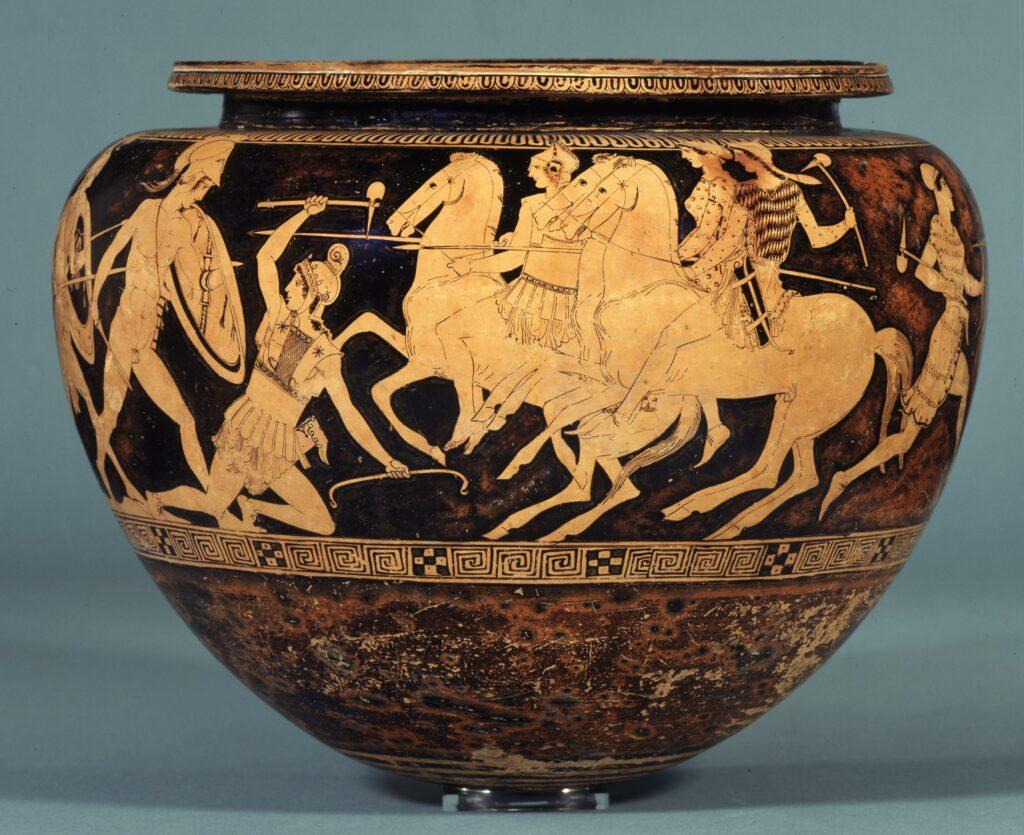
The Amazons occupy a category the Greeks built specifically to remain unstable. They are not women who happen to fight, nor men disguised as women, nor even, straightforwardly, a "third sex" — they are a deliberate refusal to resolve into any single category, and it is this refusal, this essay argues, that constitutes their cultural function.
This essay will first examine the linguistic instability built into the Amazons' own epithet in Homer; it will then turn to the visual and mythographic evidence for their androgyny, particularly their kinship with Athena; and finally it will consider why ancient and modern commentators alike have so often preferred to deny that the Amazons were women at all, arguing that this denial is itself part of the same anxious pattern the myth was built to manage.
The Amazon as antianeirai
The clearest evidence that Greek culture-built ambiguity into the Amazons from the outset is linguistic, not iconographic.
In Iliad 3, Priam recalls a campaign in Phrygia during which he and his allies faced the Amazons, whom he calls antianeirai — "a match for men," or "the peers of men" (Hom. Il. 3.171). The same epithet recurs later in the poem, when Glaucus recounts Bellerophon's trials, the last of which was a battle against "the Amazons, women the equals of men" (Hom. Il. 6.186). The fact that Homer reaches for this exact compound twice, in entirely separate episodes, suggests it was not an isolated turn of phrase, but the fixed, formulaic way the epic tradition had of naming the Amazons — which makes its internal contradiction all the more significant.
Antianeirai is built from anti- ("against," "matching," "equivalent to") and anēr ("man," specifically in his gendered, martial capacity) — yet it is inflected with the feminine plural ending. The word names the Amazons as functionally male in the one area — combat — that most rigidly defined Greek masculinity, while grammatically insisting on their femaleness. As Hardwick observes, this double gesture means that "in war the Amazons have not only the appearance but also the fighting strength of men," while the ending "highlights their gender despite their male type and role" (Hardwick 1990: 15). The Amazons, in other words, are not mislabelled as men, nor are they women who have simply adopted masculine behaviour — the language refuses to let either half of the identity cancel the other out. It is worth noting that this is not merely a modern reading imposed on the text: Hardwick argues that the very connotations of the word "Amazon" oscillate, even in antiquity, "from a slightly comic praise of sporting excellence in women to underlying insinuations that Amazons are not quite feminine," carrying "unusual or even threatening associations" precisely because the Amazons exist "outside the normal parameters of life-style" available to a Greek audience (Hardwick 1990: 14). The instability, then, is not a gap in the sources — it is the content of the myth.
As Tyrrell argues, Greek myth functioned as a form of moral and social instruction: myths "provided precedents and examples that guided choice by offering actions with known outcomes for imitation or avoidance," and their very existence in the tradition was taken as sufficient "to guarantee the historicity of its events and characters" for a Greek audience (Tyrrell 1984: 1). If myth's role was to model choices and their consequences, a figure who could not be stably classified as man or woman was not a narrative accident but a tool — one used, as this essay argues, to think through the boundary of gender itself rather than simply to police it. Dowden's description of the Amazons as "a familiar sight in the Greek mythological landscape" who have nonetheless "encroached on the social role of men" captures exactly this paradox: familiarity and transgression coexist in the same figure (Dowden 1997: 97).
Androgyny and Athena
If the antianeirai epithet shows ambiguity built into language, the visual and mythographic record shows the same instability built into form. Maartel Bremer identifies an "uncanny similarity" linking Amazons to another hybrid figure of Greek myth, the Centaurs: both are capable of standing "outside the realm of masculine humanity" while never fully leaving it (Maartel Bremer 2000: 52). For the Centaurs, this liminality is anatomical — half man, half horse. For the Amazons, it is behavioural and visual: they are, in Maartel Bremer's phrase, invaders of "the realm of masculinity" who nonetheless remain grammatically and in myth, women (Maartel Bremer 2000: 52).
This androgyny is not merely implied by combat prowess; it is visible in the earliest surviving depictions. On the Tiryns shield (Figure 1) — one of the oldest artistic renderings of Amazons, in Subgeometric style — the figures are marked as female only through "the faint indication of breasts" and a comparatively small torso, set against long, heavily patterned garments (Langdon 2008: 68, citing the shield's fig. 2.1). Langdon notes that these slit skirts "derive from Oriental, specifically Assyrian dress," a costuming choice shared with other female figures in Greek art, such as the Gorgons (Langdon 2008: 68). This is itself telling: the visual vocabulary used to mark the Amazons as foreign is borrowed from the vocabulary used to mark monstrosity. Femaleness here is present, but minimal, almost an afterthought layered onto a figure whose main visual signals — armament, posture, scale — are otherwise coded male.
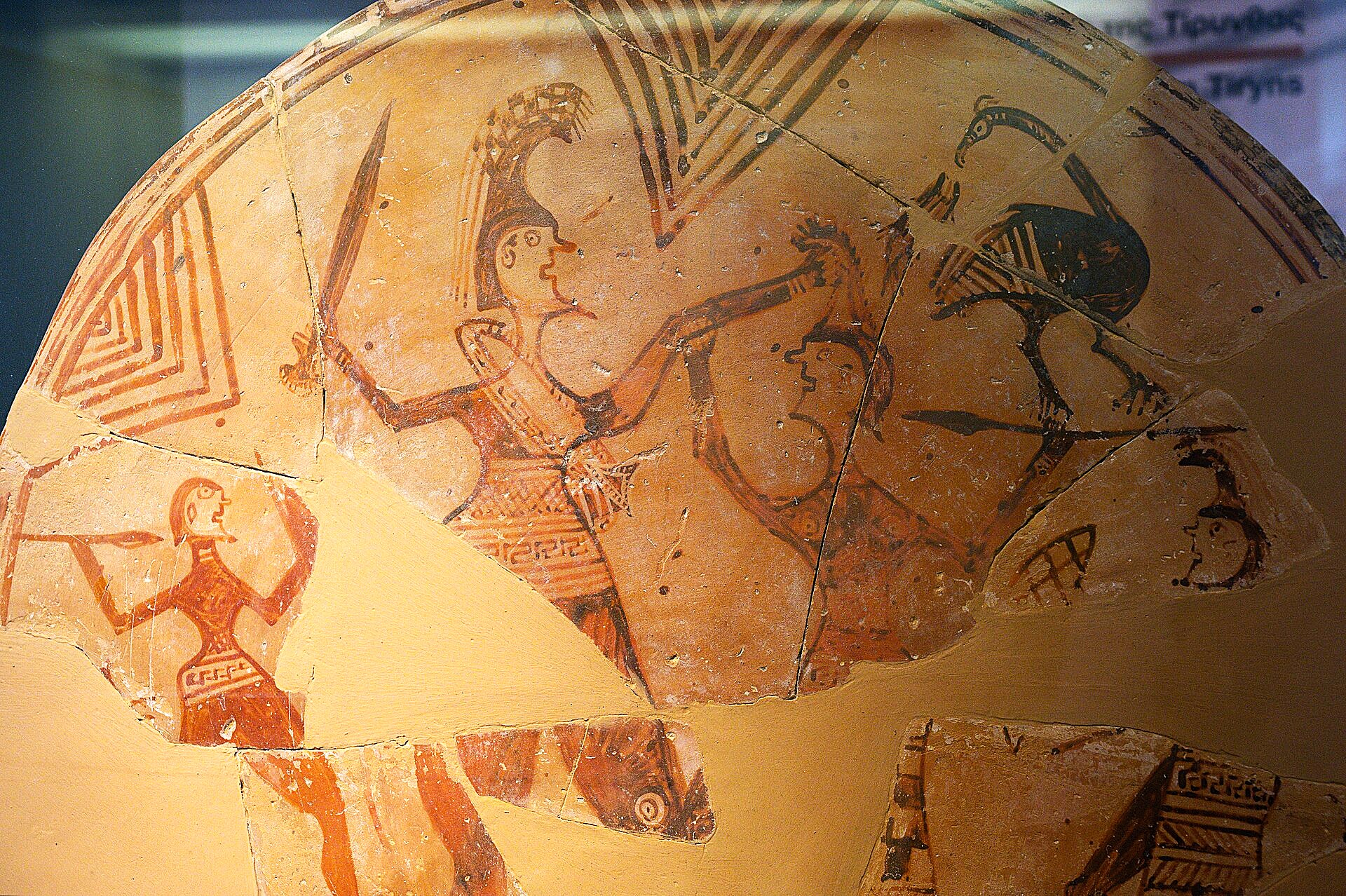
Figure 1. Terracotta votive shield from Tiryns, early 7th century BC, Archaeological Museum of Nafplion (Zde 2020).
Langdon's broader argument is that this is not incidental but constitutive: the Amazons' "initial importance" in the tradition is precisely that they are female warriors, and their androgyny should be read as "both masculine and feminine" rather than a failed or incomplete femininity (Langdon 2008: 76–77). Crucially, Langdon resists Hardwick's suggestion that the Amazons represent "a direct opposition to the then developed conventions of the Greek oikos" (Hardwick 1990: 17), arguing instead that there is little evidence in the earliest sources, such as Homeric epic, that domestic or household values are being rejected at all — the Amazons are simply, from the outset, warriors, without needing to be read as a repudiated housewife (Langdon 2008: 76–77).
What makes this androgyny more than an isolated curiosity is that it links the Amazons to the one Olympian goddess who shares the same visual and conceptual instability: Athena. Like the Amazons, she is regularly rendered with androgynous qualities and is herself a female warrior, whose competence in the martial sphere does not compromise, but rather defines, her divinity (Langdon 2008: 77). The parallel suggests that androgyny in the Amazon myth is not a marker of deviance from a Greek ideal of femininity, but a trait shared with the patron goddess of the very city — Athens — that produced so much of the art depicting Amazons as enemies. The Amazons, on this reading, are not simply Athenian others; they are dark mirrors of an androgynous ideal Athens itself already sanctified in Athena.
Doubting the Amazons were women at all
If ambiguity is the myth's substance rather than its flaw, it becomes significant that a strand of ancient and modern commentary responds to that ambiguity by resolving it — specifically, by denying that the Amazons were women at all. Strabo, writing at the start of the first century AD, is, in Hardwick's assessment, "the one source which self-consciously attempts to bring together several layers of meaning" surrounding the Amazons, doing so in order to discredit them (Hardwick 1990: 19–20).
Strabo supplies what looks like "apparently precise geographical information," locating the Amazons in the mountains above Albania and describing their daily occupations — planting, and the training of horses (Hardwick 1990: 19–20). He also records their reputed military specialism, that they "specialise in throwing the javelin," and the practice of searing off the right breast in infancy to free the arm and shoulder for combat (Hardwick 1990: 19–20). Yet having assembled this ethnographic detail, Strabo pronounces the Amazons "beyond belief," rejecting outright the idea that "an army of women" could exist, since he judges women incapable of the political organisation such an army would require (Hardwick 1990: 22). The doubt, tellingly, is not empirical but ideological: Strabo does not argue the evidence is thin: he argues that women, as he understands the category, are constitutionally unable to do what the Amazons are said to have done, and so the Amazons must not really have been women.
Bisset extends this same manoeuvre in a modern register. Pointing to the Amazons' extreme bravery and their capacity to challenge heroes as formidable as Heracles, Bisset treats these masculine-coded traits as evidence against, rather than a complicated part of, their femininity (Bisset 1971: 150). He proposes instead that the legend originated in the first encounter of Europeans "with a beardless small-statured race of bow-toting mongoloids" — steppe nomads whose ambiguous gender presentation, filtered through Greek unfamiliarity, hardened into myth (Bisset 1971: 150). Bisset supports this with reference to Russian excavations of frozen tombs in southern Siberia, arguing that these confirm the inhabitants of the region in antiquity were "Scythians, not Huns or Mongols" (Bisset 1971: 150). Whatever the ethnographic merits of this theory, its function within the argument is identical to Strabo's: masculine-coded competence is treated as disqualifying evidence against womanhood, rather than as a challenge to how womanhood itself is being defined.
This pattern gains further weight from Herodotus's account of the Amazons' descendants, the Sauromatae, who resulted from unions between young Scythian men and a band of Amazons shipwrecked on the Scythian coast (Hdt. 4.110–117). Herodotus reports that the Amazons agreed to marry only on the condition that they retain their horses, weapons, and hunting habits, and that Scythian women's domestic customs held no interest for them (Hdt. 4.110–117) — meaning that even once assimilated into a settled, intermarried community, the Amazons' mythographic function is to resist, rather than complete, the transition into conventional femininity. The Sauromatian women, in Herodotus's account, continue to ride, hunt, and fight alongside men. Read against Strabo and Bisset, Herodotus's version suggests that the anxiety provoked by the Amazons was never really about whether they were biologically women, but about their refusal to let womanhood mean domestic settlement — and that refusal is precisely what later writers, uncomfortable with an unresolved category, tried to write out of existence by questioning their womanhood altogether.
Conclusion
The Amazons, across the sources examined here, resist every attempt to fix them into a single stable identity. Homer's antianeirai names them as functionally male while grammatically insisting on their femaleness; the earliest visual record marks their femininity as minimal and layered onto an otherwise masculine-coded form, while linking them, through this same androgyny, to Athena herself; and the sceptical tradition running from Strabo through to twentieth-century scholarship like Bisset's responds to this instability not by accepting it but by trying to argue it away, denying the Amazons were women at all, rather than admitting that Greek and modern categories of womanhood might simply not contain them.
Langdon's conclusion that the Amazons remain "undeniably female" while retaining the masculine characteristics that define them in myth, should therefore be read not as a compromise between two positions, but as the myth's actual, intended point (Langdon 2008: 77). Their political function, as Hardwick argues, was never only to represent Athens's enemies in a strange and unusual guise, but also to "highlight Hellenic values" by embodying their negation (Hardwick 1990: 19–20) — and they could only perform that function by remaining exactly what the tradition, and its later interpreters, found so difficult to tolerate: neither fully woman, nor fully man, nor safely either.
Bibliography
Primary sources:
Herodotus, Histories 4.110–117.
Homer, Iliad 3.171, 6.186.
Secondary sources:
Bisset, K. A. (1971). 'Who Were the Amazons?', Greece and Rome, 18(2), p. 150.
Bremer, J. M. (2000). 'The Amazons in the Imagination of the Greeks', Acta Antiqua, 40(1–4), pp. 51–59.
Dowden, K. (1997). 'The Amazons: Development and Functions', Rheinisches Museum für Philologie, 140(2), pp. 97–128.
Hardwick, L. (1990). 'Ancient Amazons: Heroes, Outsiders, or Women?', Greece and Rome, 37(1), pp. 14–37.
Langdon, S. (2008). Art and Identity in Archaic Greece, 1100–700 BCE. Cambridge: Cambridge University Press.
Tyrrell, W. B. (1984). Amazons: A Study in Athenian Mythmaking. Baltimore and London: Johns Hopkins University Press.
Images:
British Museum. Red-figured dinos (mixing bowl) with Theseus and the Amazons. Collection online, museum number G 1899,0721.5. Available at: https://www.britishmuseum.org/collection/object/G_1899-0721-5
Zde (2020). Terracotta votive shield, early 7th century BC, Archaeological Museum of Nafplio, 202279. Wikimedia Commons. Available at: https://commons.wikimedia.org/wiki/File:Terracotta_votive_shield,_early_7th_BC,_AM_of_Nafplio,_202279.jpg

The author
First Class (Hons) BA in Archaeology of Ancient Civilisations | Specialising in Myth, Reception, and Visual Culture in Ancient Greece | MA in Art, Philosophy and Cultural Institutions
All work by this author →Read next, in Classics
- The Art of Persuasion: Characterisation and Narrative in Lysias’ Forensic Oratory Emily Miles
- The women of Herodotus’ Histories Vlada Kampane
- Blood and Fire: Troy in Heavy Metal Vlada Kampane